
The Last Scream: Poq (Single)
Single Release Date
18/04/2025
Catalogue Number
ES003-2s
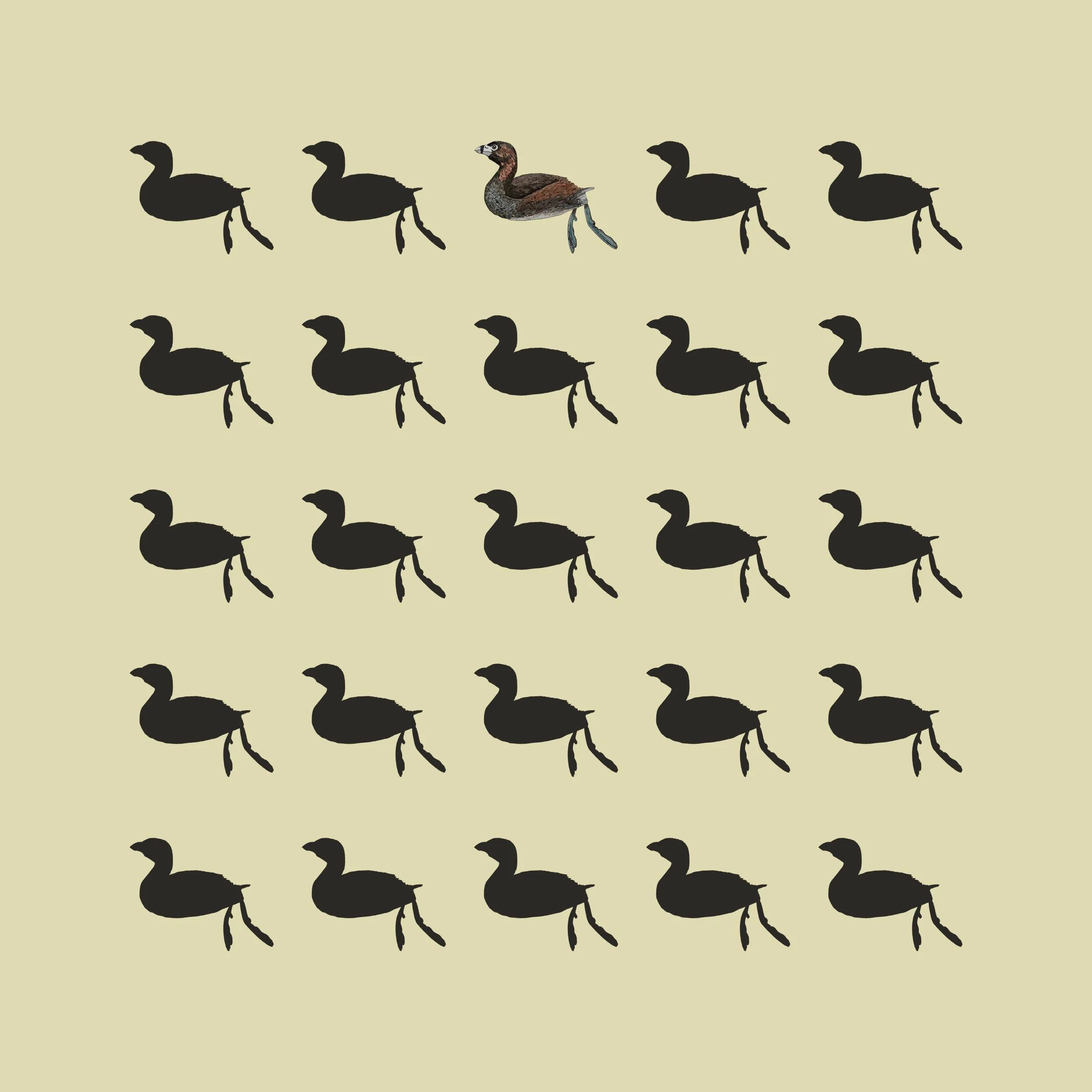
A brand new single from The Last Scream album series was released 18th April 2025 ahead of Earth Day, featuring the sounds of the extinct Atitlán grebe (Podilymbus gigas) and Guatemalan artists Ch’umilkaj and Alex Hentze.
The release of Poq follows the debut album in The Last Scream series released earlier this year. The series aims to raise awareness of connections between climate change, biodiversity loss and extinction, using the voices of diverse species and the extraordinary artists who have created new music with them. Climate change and biodiversity loss have been linked throughout Earth’s history, but human activities in the modern era are accelerating both at unprecedented rates, with feedback loops worsening both crises.
The Atitlán grebe is an extinct water bird native to Lake Atitlán, Guatemala. First described internationally in 1929, American ecologist Anne LaBastille (1933–2011) worked for 25 years to save it. She later reflected on witnessing its “agonizing plunge into oblivion” firsthand, citing invasive fish introduction from the late 1950s, the 1976 Guatemala earthquake, pollution, habitat loss, and regional conflict in the 1980s. Conservation efforts were hindered, and in 1982, a game warden she hired, Edgar Bauer, was murdered. The last two grebes were seen in 1989.
The Maya people of Atitlán are predominantly Tz'utujil and Kaqchikel, and the lake is surrounded by villages in which indigenous Maya culture is still present. The grebe’s local name was poc (or poq in Tz'utujil) after the ‘poc-poc-poc’ sound it made. LaBastille was affectionately known as ‘Mama Poc’ (mother of the grebes).
The song ‘Poq’ was created by Kaqchikel singer-songwriter Ch’umilkaj and electronic musician Alex Hentze. It incorporates a 1963 recording of Atitlán grebe courtship displays by LaBastille—possibly the only one in existence. Hentze created an electronic foundation based around bird’s sounds, while Ch’umilkaj wrote the vocal melody in Kaqchikel, inspired by memories of the poc, shared by Santos Sacarías Mendoza Pérez (78), a Tz'utujil elder from San Juan La Laguna.
This song is dedicated to Anne LaBastille, Edgar Bauer, and the Kaqchikel and Tz'utujil elders on whose memories of the poc we depend. Special thanks to Leslie Surprenant and Santos Sacarías Mendoza Pérez.
“The call of the poc, an extinct bird from Lake Atitlán, was a sound that evoked a lot of nostalgia and helplessness in me, so as a co-artist of this song it implied an enormous responsibility, firstly to understand the causes of its extinction and secondly, to listen to and reconstruct anecdotes from elders who still live in towns near the lake to share what they remember about this bird.” — Ch’umilkaj
“My experience working with the sounds of the poc was truly beautiful. One of their calls has an unmistakable rhythm, which made it very easy to develop. This organic element blended seamlessly with the rhythmic base I worked on, creating a unique atmosphere that I think complements Ch’umilkaj’s voice.” — Alex Hentze
The research and artistic collaboration for this track was carried out and facilitated by EarthSonic Sounds Archive Manager, Merlyn Driver
“Anne LaBastille was an inspirational and pioneering ecologist and author who spent decades trying to save the Atitlán grebe. It’s been an honour to facilitate this collaboration, which couldn’t have happened without Alex, Ch’umilkaj, Anne, the grebes, and some of the indigenous elders who still remember the poc. I hope Anne would have liked it.” — Merlyn Driver
This release is part of EarthSonic, a global project from In Place of War thatworks with indigenous communities, musicians, cultural organisers, scientists, climate activists and experts to tell the story of climate change through music.
Working with scientists from around the world, EarthSonic created two new wildlife sound collections for The Last Scream – the first in collaboration with the Fonoteca Neotropical Jacques Vielliard (FNJV) archive (from the Museu de Diversidade Biológica – UNICAMP, Brazil), which is curated by Professor Felipe Toledo; and the second including sounds collected from individual scientists and institutions, curated by EarthSonic’s Sounds Archive manager and musician/nature sound recordist Merlyn Driver.
The album’s artists were invited to listen and respond to these sounds, aiming to bring to life what is often in danger of extinction or no longer exists.
